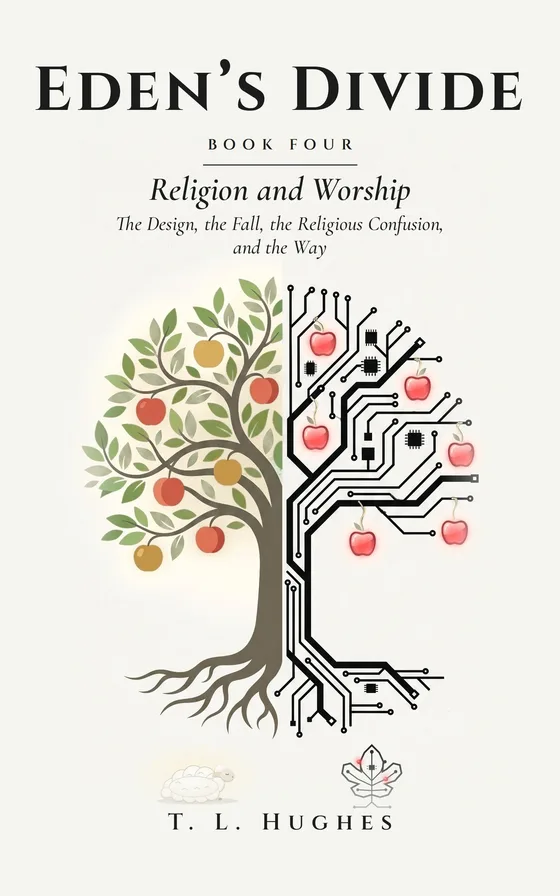
Eden's Divide, Book Four
Religion and Worship: The Design, the Fall, the Religious Confusion, and the Way
Ce livre est écrit en anglais.
Deux sortes de religion : celle où l'homme se couvre lui-même, et celle où Dieu couvre l'homme.
À propos du livre
In September 1893 the first Parliament of the World's Religions was told that all religions are streams rising in different places and flowing into the one sea. A century later, that conviction has become the creed of the West.
Eden's Divide, Book Four traces the confusion of our age about God and worship back to the garden: to the fig leaves that Adam and Eve sewed for themselves, and to the coats of skins that God made and with which he clothed them. From that day there have been two kinds of religion in the world: the religion in which man covers himself, and the religion in which God covers man.
The book follows one argument through five parts:
-
The Design: worship before religion, the one God, man the priest of creation, and the God who speaks
-
The Fall: fig leaves, the two altars of Cain and Abel, Babel and Babylon, the golden calf, and the great exchange of Romans 1
-
The Prophets of Religion: the gods of Egypt and Greece, Zoroaster, Hinduism and the Sikh faith, the Buddha and the Jains, Confucius, Lao Tzu and Shinto, African traditional religion, Judaism after the Temple, Islam in two chapters, the Gnostics, Freemasonry, the deists and Kant, Freud and Jung, the Latter-day Saints and the Watch Tower, Theosophy, the New Age, the occult revival, and the new atheists and pluralists, each heard fairly from its own sources and weighed against Scripture
-
The Religious Confusion: all roads to God, moralistic therapeutic deism and the prosperity gospel, the spiritual but not religious, the new gods of politics and technology, and Christ without the cross
-
The Way: the claim of Christ, the Lamb God provides, worship in spirit and in truth, and the city with no temple
Every chapter states each religion's case at full strength, grants what must be granted, shows where it breaks, examines the harvest it has produced, and brings it to the Word of God as the final authority. Rumour and caricature are set aside; every religion is judged by what it actually teaches. All Scripture is quoted from the King James Version.
This is not a book of contempt for the religions of the world. It is a sustained argument that every religion of man is a covering sewn by human hands, and that God has provided the covering no man could make: "Behold the Lamb of God, which taketh away the sin of the world." (John 1:29)